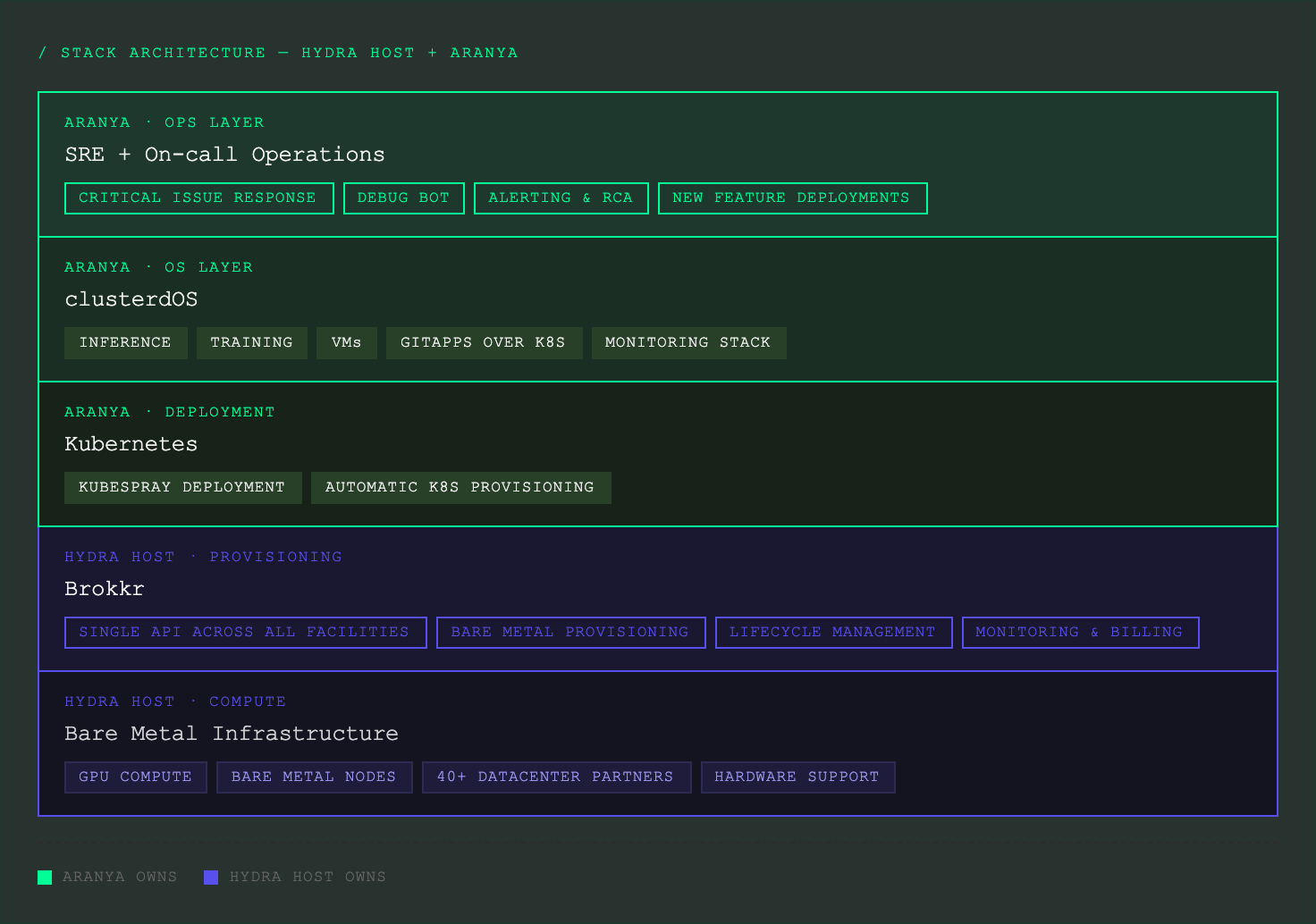
Hydra Host provides bare metal compute and operational support to AI inference and training companies. By layering Aranya's clusterdOS on top, their customers reach production-ready Kubernetes without building a platform team — and a stack that survives unique datacenters and hundreds of hardware configurations.
 ×
×
Hydra Host's customers needed more than bare metal; they needed a path to production Kubernetes that didn't require hiring a platform team or chasing datacenter tickets. By bringing in Aranya for the Kubernetes layer, built on clusterdOS, Hydra Host now ships customers production-ready clusters in 24–48 hours, with cluster issue resolution time cut by 90%.
Bare metal compute, operational support, AI customer focus
Hydra Host provides bare metal GPU compute and operational support to AI inference and training companies. The company works across a network of 40+ datacenter partners, unified through Brokkr — a single API that normalizes provisioning, lifecycle management, monitoring, and billing across facilities and hardware stacks. That unified foundation is what makes Hydra Host fast at sourcing GPUs when customers need them, and what gives Aranya a consistent layer to build on regardless of which facility a cluster lands in.
The gap between bare metal and a production cluster
When a node goes down at 2 a.m., the path back to healthy depends on what's underneath it. If a bare metal provider stops at the rack, the customer is responsible for everything above it, and the operational cost is real.
For AI inference and training companies running production workloads on bare metal, the operational layer is genuinely complex. That's where the Hydra Host and Aranya partnership comes in: production-ready clusters in 24–48 hours, with a team on call for whatever comes next.
Multiple consumption patterns, one coordinated stack
AI customers consume GPU compute in different shapes: directly on bare metal, in VMs, through Kubernetes, or via Slurm scheduling. Most providers force customers to pick one and leave the operational complexity with them.
Hydra Host's bare metal compute pairs with Aranya's clusterdOS — an open-source distributed OS for Kubernetes — to support those consumption patterns from a coordinated stack. Hydra Host owns the bare metal layer and operational support. ClusterdOS handles Kubernetes natively, with Slurm and VMs running on top of K8s. Customers stop choosing between bare metal performance and managed cluster operations.
"A growing number of customers need more than raw infrastructure. They need a faster, more reliable path to production. This partnership with Aranya brings together Hydra Host's bare metal compute and operational support with Aranya's Kubernetes expertise — giving customers a more complete solution for deploying and scaling real workloads with less complexity."
Aaron Ginn · Co-founder & CEO, Hydra Host
Kube-native networking, no datacenter dependencies
Bare metal environments vary. Each datacenter has its own networking constraints, and how external traffic reaches a Kubernetes cluster depends on what the facility supports. Aranya handles this with two configurations, deployed based on what each facility allows.
Where a datacenter permits Cilium L2 announcements, Aranya relies on the datacenter providing a public IP that is NATed and routed to the Cilium L2-announced IP — a clean path that uses the facility's existing routing infrastructure. Where L2 announcements aren't available, Aranya provisions a fully managed HA proxy cluster, configured to handle high request volumes. Aranya operates both configurations in production across Hydra Host's facility network, and the choice between them is transparent to the customer.
The result is direct kube-native routing via Cilium's eBPF dataplane, with the cluster routing around datacenter networking quirks instead of breaking when they appear. The same pattern is now live across Hydra Host's datacenter facilities.
What customers on the joint stack see in production
A leading AI inference company runs over 1,700 GPUs across the joint stack. The numbers below are from production deployments, not projections.
"Bare metal is where serious AI workloads belong. Hydra Host makes that supply real. We make it production-ready."
Christian Ondaatje · Co-founder & CEO, Aranya
Scaling the joint footprint
As AI workloads scale, the operational layer is increasingly where production gets won or lost. The companies shipping fastest aren't the ones with the most GPUs. They're the ones whose clusters were ready when the workload arrived.
Hydra Host and Aranya are scaling the joint footprint across new facilities and new customers. ClusterdOS is the reproducible operational layer underneath, and every new deployment is faster than the last.